
roots
knowing from the invisible realm.

I like to think of my neurodiverse nervous system as a root system. Plants are one of my special interests (I am a Master Gardener in Salt Lake City and a Naturalist II in California because I won’t and I can’t stop), so this just makes sense to me. Neurotypical people tend to learn from external stimuli, like the visual and auditory experiences in a typical classroom or meeting room. While I learn this way too, particularly through reading, learning environments often contain a lot of information that I am unable to process or that is otherwise challenging to understand. Most people learn their way through life. I feel my way through life. I learn through experience and movement.
By this, I mean I gain knowledge from how experiences make me feel, and how my nervous system processes those feelings. I gain knowledge through embodiment. I feel it in my bones, my flesh, my heart, my gut, my skin. Knowledge becomes part of me. This is one of the hardest things for me to translate into ways that others may understand, but I am going to give it a try.
tapestries of communities
I imagine the neurotypical and neurocomplex experiences as a forest. The abundant world above ground is full of light and air and flora and fauna. There are many layers to a forest, from the floor to the emergent layer above the canopy. Each layer has a unique tapestry of habitats and species. This represents the neurotypical world. We can all walk in a forest, but the experience is different for everyone. We see, hear, and feel different things. For some people, the leaves on a tree are a beautiful piece of art, and others find more joy in songbirds. There is a lot of activity, variety, and different ways of experiencing all that the above-ground has to offer. A symbiosis between flora and fauna maintains an ecological balance and sustains life. It flows. It is beautiful.
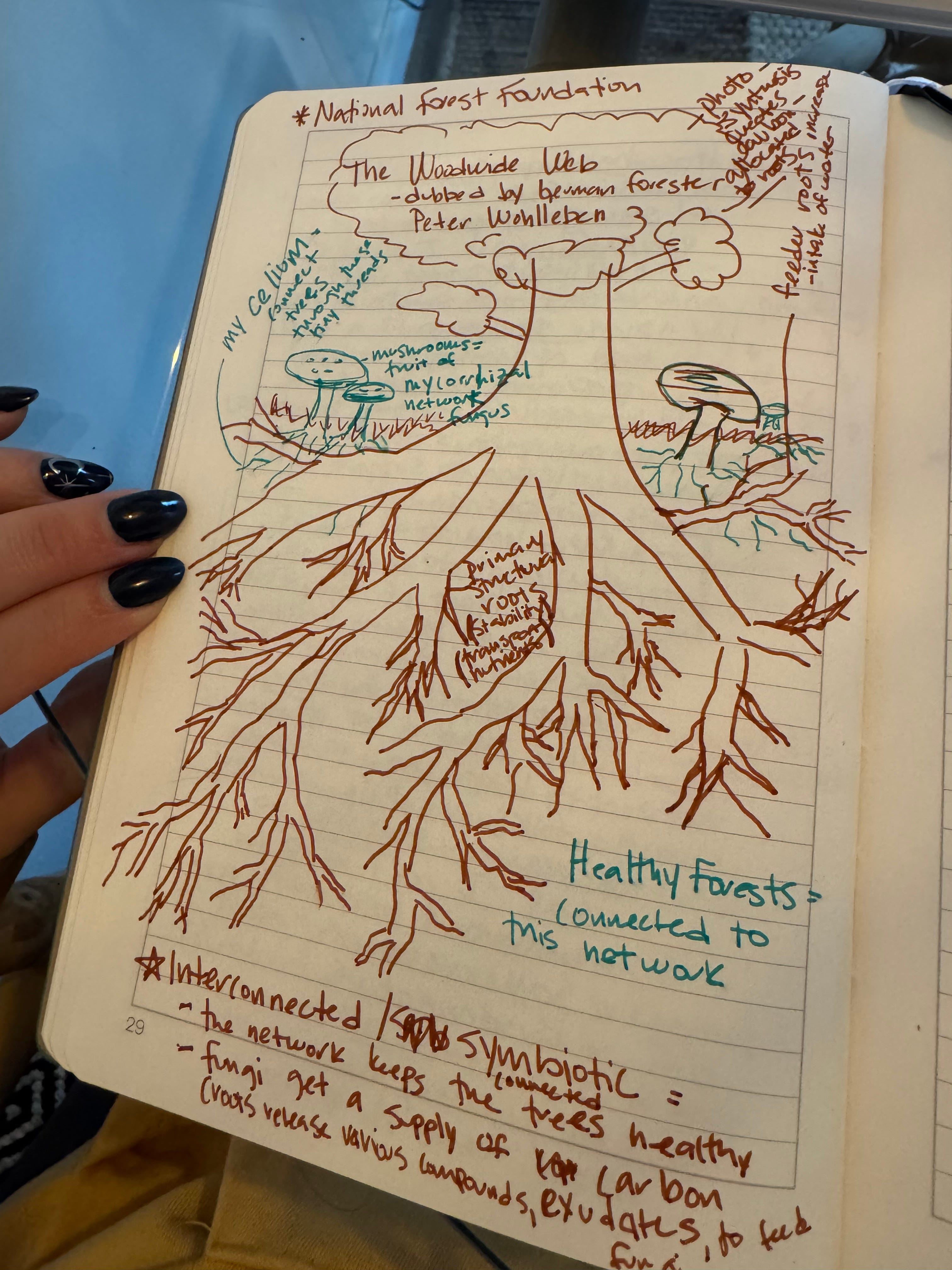
Below the forest is a complex root system that operates out of sight. This represents the neurodiverse world. The root systems in healthy forests are connected via a mycorrhizal network, a network of tree roots and fungi. A German forester, Peter Wohlleben, named this network the woodwide web. The web consists of tree roots and tiny mushroom root threads, the mycelium. They have a symbiotic relationship in which they exchange information and nutrients, preserving the health of the forest. The mycorrhizal network retains and generates nutrients, sustaining the life of the trees and mushrooms connected to the woodwide web.1
The root system anchors the forest, functions primarily out of sight, has a dynamic and constantly growing architecture, and is responsible for acquisition, structural support, and communication. The older and seasoned trees have deeper roots, a larger fungal network, and more resources. A mature tree receives a chemical message through the mycorrhizal network and coordinates a supportive response. For example, a mature tree can receive a signal that trees on the other side of the forest are under an invasive insect attack and send nutrients to strengthen the trees’ response in that part of the forest. The mature tree knows what nutrients to send to a young sapling to sustain growth in an area with inadequate sunlight.
The above ground world had vastly different ways of being than the world below ground. There are different sources of nutrients and different ways of giving and receiving information. But both worlds are necessary for a forest to thrive. The above ground network communicates and transfers nutrients to the below ground network, and the below ground network, in turn, responds to reallocate resources that support the above ground network. This is how the ecosystem balances itself.
restoring balance
Like a mature tree given the resources to grow deep, healthy roots, some neurocomplex nervous systems are capable of sensing imbalance in society, but rather than sharing this knowledge and working with their community to restore balance, their insights have been invalidated. This leaves them unable to reallocate resources (physical, mental, environmental) to restore balance and alignment, ultimately strengthening the societal system as a whole. Neurodiverse knowledge is not meaningfully integrated into society and systems of knowledge. In fact, our knowledge and experiences have been pathologized in a way that invalidates, punishes, and often isolates the individual through institutionalization, imprisonment, or because it is harder to build and maintain relationships.
The demand for a neurocomplex person to demonstrate their knowledge through traditional Western academic pathways forces them to participate in activities that can be mentally and physically uncomfortable, even painful. We are asked to translate our knowledge into neurotypical ways of understanding. Imagine if a neurotypical person were forced to exclusively participate in an academic setting designed specifically for neurodiverse individuals, and to translate what they deem as ‘knowledge’ or ‘Truth’ into embodiment, or how it makes their body feel, and express that knowledge using methods of communication in a language they were never taught.
When knowledge is embodied rather than externalized or othered, social constructs are muted, make little sense, and are often missed altogether. Many neurodiverse individuals have strong value systems and participate in social environments or are with people who oppose those values. For me, this can cause physical discomfort and pain. The most effective way to relieve that pain is to shift to an environment that aligns with my value system, or work to create one.
For example, I am unable to differentiate between harming one individual and harming humanity as a whole. It is painful to allow any one person to suffer due to social constructs, no matter what their relationship to me is. The adage of ‘treating everyone the same no matter who they are’ is often used to demonstrate how we should be as kind to someone in a service level position as we are to someone in a higher, executive level position. Treat the custodial staff as ‘kindly’ as you would treat the executive director. This seems to only apply to socially constructed things like being kind when our trash is emptied by saying thank you and politeness like saying hello in an elevator, but not to addressing root needs like food, housing, health and mental care, a support system, and a community of belonging.
This need for alignment with values (between the inner and outer worlds) has been pathologized as “justice sensitivity,” often defined as a sensitivity and an emotional response to perceived injustices.2 It is not a sensitivity. It is a nervous system capable of embodying the complexities of the environments we inhabit and feeling the imbalances within them. Concepts and constructs that do not align with our values, ethics, or morals, and that make our bodies physically uncomfortable or even painful, are forced on us as ‘the way it is,’ ‘the way it must be done.’
At the same time, neurodiverse people are often criticized as lacking empathy. This is not a lack of empathy or caring, but rather an abundance of caring.3 Rejecting the social construct that places one person’s worth above another’s based on their personal network or capital. The world wants us to ignore the signals we receive indicating a redistribution of resources to an individual who needs support. Ignoring what I know through embodiment makes me feel physical discomfort or pain, and the discomfort or pain is amplified by other stimulation. My nervous system reacts to this misalignment by rejecting noise, light, most types of food, and touch, and the physical discomfort becomes so intense that communication becomes more challenging. The need for alignment is so strong that I start to lose my ability to communicate or ask for what I need in that moment, especially when that need is at odds with society at large.
This inability to communicate within a socially constructed role is described as distracted or inattentive. But, for me, it is actually paying too much attention to things that do not align with social collective identities. This can be perceived, and even pathologized, as not paying attention to the same things that others are paying attention to.
For example, shopping in the grocery store means searching for foods that my body will most likely accept, which are often foods in their most natural state, and foods that are farmed and produced in alignment with my value system.4 The environment is often loud, music is playing, people are chatting, carts are everywhere, and I am unable to focus on what I am doing. To make the food choices that most align with my body and needs, which are hard to locate in the typical grocery store. From the outside, this can look like I am not focusing on what I came for, to quickly put items on my list in my cart and get on my way. It is as if grocery stores are designed so we don’t think and just impulse-buy everything we see, boosting profits. There are even stores designed to make us feel like we are making choices in line with our values, when in truth, they are not.
In my youth, being concerned about humanity as a whole, our planet, and animals were mostly supported. As an adult, these interests were treated as cute youthful aspirations, something I was supposed to outgrow, and get married (which I did at 19), have children, and have my family become my new value system.5 That I would shift my values to align with social identities. My adult children and my partner remain my top priorities, and my overall value system has remained intact. However, living in alignment with personal values in a capitalist society can come with serious consequences, including low income, difficulty finding a job, and limited access to critical resources such as health care, food, and housing.6 This is an area I have a lot of experience with, and will be diving into in the future.
I imagine a world where the myriad neurocomplex identities collaborate with the neurotypical world. A world where our knowledge systems integrate neurodiverse ways of knowing and being. A world that recognizes identities may have multiple intersections between race, disability, gender, sexuality, social class, access to education, immigration status, and more. A world where misalignments are taken seriously, and communities of practice use care to recalibrate for alignment. A world where the entire ecosystem of the forest functions in symbiosis. A world where individuals and relationships matter.
This is not a new concept. There is a vast knowledge base on liberation, justice, abolition, advocacy, and organizing on anti-racism, disability, civil rights, gender, LGBTQ, immigration, political identities, and other worldwide justice movements. We must work together on the future we want to build, because as Audre Lorde said back in 1982, “There is no such thing as a single-issue struggle because we do not live single-issue lives.”7
This work must not be done in a silo. It must move forward as a community, with many groups collaborating to build consensus. Mariame Kaba talks about accountability being built into the work of organizing, and the work of an individual as an advocate, as the act of self that lacks accountability.8 Advocacy alone can only take us so far. We must come together as diverse groups in commitment and accountability, and to the hard and slow work of building understanding together.
I am still learning about the neurodiverse community. Who are your favorite organizers in this space? What work do you see happening in your communities? How do you participate?
For more, see: National Forest Foundation. “Underground Networking: The Amazing Connections Beneath Your Feet - National Forest Foundation,” February 23, 2026. https://www.nationalforests.org/article/underground-mycorrhizal-network/.
Justice is a complex topic that goes far beyond what I discuss here. Justice sensitivity was first introduced in 1995 and has since been widely discussed. See: Schmitt, Manfred J., Roland Neumann, and Leo Montada. “Dispositional Sensitivity to Befallen Injustice.” Social Justice Research 8, no. 4 (December 1, 1995): 385–407. https://doi.org/10.1007/bf02334713.
I like how Autistic Science Person discusses this in “Autistic People Care Too Much, Research Says,” NeuroClastic, July 11, 2022, https://neuroclastic.com/autistic-people-care-too-much-research-says/, under “Reframing.”
Neurodiversity and food tolerances is something I am diving into and will discuss much more in a future post.
For more on autistic women conforming to society, see: Mo, Stella, Nina Viljoen, and Shivani Sharma. “The Impact of Socio-cultural Values on Autistic Women: An Interpretative Phenomenological Analysis.” Autism 26, no. 4 (August 13, 2021): 951–62. https://doi.org/10.1177/13623613211037896, under “Subtheme: expectations to change and conform.”
I like how Autistic Science Person talks about this in: Autistic Science Person, “Autistic People Care Too Much, Research Says,” NeuroClastic, July 11, 2022, https://neuroclastic.com/autistic-people-care-too-much-research-says/, under “Real World Implications – Autistic Employment and Poverty.”
Read Lorde’s full address to Harvard University here: BlackPast, “(1982) Audre Lorde, “Learning From the 60s”,” BlackPast.org, May 1, 2025, https://blackpast.org/african-american-history/1982-audre-lorde-learning-60s/.
See: Kendal Harris, “Kaba, Mariame. (2021). We Do This ‘Til We Free Us: Abolitionist Organizing and Transforming Justice. Chicago, IL: Haymarket Books. 203 Pp. ISBN: 978–1-64,259–525-3,” Journal of African American Studies 26, no. 4 (December 1, 2022): 521–22, https://doi.org/10.1007/s12111-022-09605-2.
I feel like we could run a podcast about nature versus nurture and discuss the nuances of brain development and what is “fixable” versus dropping the belief that we need to be “fixed.”
So much of this is true for so many individuals who may not even know how true it is for them until they read your words.
And so much of this is ignited by society, upbringing, trauma and neglect doubling down on the things that felt like they served the strong sense of individuality you needed for survival through so many eras of your life.
I see you. And I adore you. You’re so awesome. Keep telling your story.